Home | Food
| Games | Friends + Family
| Jokes | Endangered Species
| Graphics + Backgrounds | Vimy Ridge
Endangered
Species of Canada
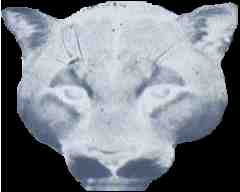 Cougar-felis
concolor
Cougar-felis
concolor
The
Cougar apparently is the largest native North American feline. The cougar
looks simply like a big cat but with one important difference, it also
has a huge long tail, this tail is used mainly for balance and maneuverability
for traveling at fast speeds and over mountainous landscapes. Most Cougars
are light brown, tanned or tanned gray. This is excellent camouflage for
it's mostly northern environment.
Just by
looking at the Cougar you can tell it is built to hunt larger animals.
It's jaw has a large gape and long sharp teeth meant for biting into prey
of larger size than itself. Long sharp claws on every digit
of each foot.
Each claw reciprocates in and out of the foot for when the Cougar is pouncing
or just walking. The Cougar's favourite food seems to tend to be white
tailed deer and mule deer which (of course) live in the same area.-Ministry
of the Environment (M.O.E)
The Cougar's territory
is very large, it spans from the bottom of Alaska right down to the Gulf
of Mexico on the west coast. Unfortunately the population is about 9/100km
squared at the highest.
Cougars die for
many reasons. Not only for the causes of man either. Since Cougars hunt
animals larger than themselves they can sometimes take many injuries in
an attack. From punctured abdomens to broken backs the Cougar suffers and
dies. Also many Cougars starve to death due to the expansion and
advancement of humans into the habitat and one of the Cougar's few food
source becomes less common or scarce, and sometimes unfortunately the Cougar
itself is as well.
The Cougar
was hunted at first when it was viewed as an enemy of European settlers.
The cougar would raid the settlers livestock alot which did not help the
species. $50 bounties were then paid for their capture. Thus the Cougar
was almost exterminated from western North America. Luckily now,
this is no longer an issue and the feline now almost completely lives in
peace with the human race.
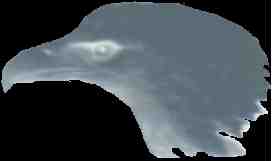 Bald
eagle- haliaeetus leucocephalus
Bald
eagle- haliaeetus leucocephalus
The largest Canadian
bird of prey; the majestic bald eagle is so well known it is resembled
on the American quarter and the Canadian $50 bill. this species has become
more than just a vicious air predator, it's abilities are envied and is
even looked upon as a symbol of courage and boldness.
the bald
eagle has a wingspan of more than 2 metres wide, weighing up past 7 kg!
The eagle has sight four times stronger than that of any human. It gets
it's traditional colours at the age of 5 years.
This symbolic
bird is spread across the continent, coast to coast. Surprisingly enough
most of Ontario is in it's territory.
All throughout
this area the eagle survives primarily on aquatic organisms, live or dead,
almost anything with food value, even roadkill. always every bird for themselves.
A pair would
build themselves a huge nest, measuring 1.5-2 metres across and 1 metre
tall, (sometimes larger!) and usually near a water source on the largest
tree in the area. -Ministry of Environment
In the nest
the female would lay a few eggs over a span of a few days. they incubate
for over a month. Once hatched the eaglings get big appetites. The oldest
eats first and would sometimes eat the youngest. "hatchlings grow
very quickly from 90g to 5000 in two months" they begin flying around the
11th week at this time they start feeding themselves. Mainly leftover
carcasses at this age. Hunting begins later in adulthood. -ministry of
the environment
The first
big decline in eagle population was due to the English settlers, who came,
destroyed their homes and stole their food and sometimes shot and trapped
the birds themselves. The population is rising again probably due
to the bald eagle act of 1940 which stopped eagle hunting; yet it still
remains an endangered species.
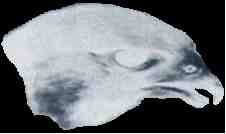 Peregrine
falcon- falco peregrinus anatum
Peregrine
falcon- falco peregrinus anatum
This bird of prey
is probably one of the fastest known birds in the world. In a dive it has
been recorded to travel faster than 300 kph. This bird's hunting techniques
are slightly unique to that of most other animal's, for one thing it does
not prey on dead animals or fish at all.
The Peregrine
Falcon will fly up and get alot of altitude then at the right time it would
dive down at other birds and plunge into it. Usually killing the prey instantly.
The falcon would then carry it to a nearby cliff or if it's too heavy would
let it drop and go down to the ground to eat.
It is easy
tell the falcon has a unique hunting habit just by comparing it's silhouette
to other birds. Infact you can tell this with most birds:
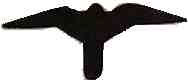
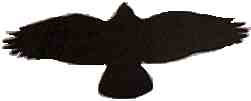
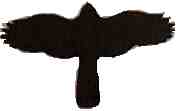
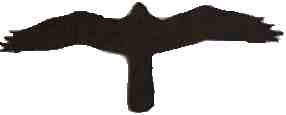
falcon- air diver
buteo- scavenger,soarer accipiter-heavy forested
harrier-water diver
bird chaser
(not to equal scales)
In the 1960's the Peregrine Falcon was hunted, trapped it's nests
were robbed and was commonly poisoned by DDT (Dichloro-diphenyl-trichloroethane).
Luckily by 1988 a recovery team came and saved the few left and began raising
them in a clean zone. The falcon population began to rise again. By 1990
there were about 1500 again. Some of the surviving falcons were then introduced
to cities as a living environment. The skyscrapers would act as big cliffs
and they would have pigeons as a primary source of food.
Home | Food
| Games | Friends + Family
| Jokes | Endangered Species
| Graphics + Backgrounds | Vimy Ridge